Integration 1

Indefinite Integrals, Definite Integrals
Area between curves
Why we study this
One of the most common characteristics of mathematics is that once a process is realised (or made real) we immediately reverse the process! We learn to subtract after we learn to add, divide after we multiply, invent (discover?) negative numbers as the inverse of positive numbers, factorise after we expand brackets, ... The list goes on!
So once we establish differentiation, we need to consider anti-differentiation. Differentiation gives us rates of change, or gradients of tangents to curves. What will the reverse process mean geometrically?
It probably comes as a bit of a surprise that integration relates to areas under graphs! It is certainly not obvious that these processes are opposites to each other.
However, you may know that the area under a velocity-time graph repesents displacement, and the gradient of a displacement -time graph represents velocity, so here is a real-world model of why gradient and area are related as opposites.
The diagram above goes some way to explaining the relationship between integration and area. With a small change in x, δx, we add an area δA to the area A. This added area approximates to a rectangle of area yδx. The extra triangle above the rectangle disappears as δx tends to zero. This is similar to the limiting process we find in differentiation.
So δA ≈ y δx and y ≈ δA/δx. In the limit this becomes y = dA/dx and A = ∫ydx.
History of Integration

Eudoxus
The history of integration reaches back to ancient Greece, where mathematicians such as Eudoxus and Archimedes used methods of exhaustion to find areas and volumes. These early ideas were important steps toward the modern integral because they treated curved shapes as collections of smaller, simpler parts. Over time, mathematicians in India, the Islamic world, Europe, and elsewhere developed new techniques for working with infinite series, areas, and changing quantities.
In the seventeenth century, Isaac Newton and Gottfried Wilhelm Leibniz independently developed calculus. Newton connected integration with motion and quantities that change, while Leibniz introduced the integral symbol and notation that made the subject easier to use. Their work showed that integration and differentiation are inverse processes, a relationship now known as the Fundamental Theorem of Calculus. Integration is now used to find areas, volumes, accumulated change, and many results in science, engineering, economics, and mathematics.
Archimedes
According to ancient accounts, Archimedes was killed in Syracuse during its capture by Roman forces in 212 BCE. He was reportedly working on a mathematical diagram when a Roman soldier ordered him to stop. Archimedes is said to have replied, “Do not disturb my circles,” before he was killed. Although the exact details may be uncertain, the story reflects how deeply he valued his mathematical work.
c. 370 BCE
Eudoxus develops the method of exhaustion to measure areas and volumes.
c. 225 BCE
Archimedes uses exhaustion to calculate areas, volumes, and curved shapes.
Newton develops his method of fluxions, an early form of calculus.
Leibniz develops integral calculus and introduces the ∫ symbol.
1665
1675

Integration Exam Tips
While you can learn separate formulae for integration, there is a danger you might get them muddled with differentiation formulae (especially for sine and cosine!). I prefer an approach which you could call 'suck it and see': guess the function which differentiates to what you want, then differentiate your guess, and adjust the constant multiplier to get the correct integral.

Indefinite Integrals
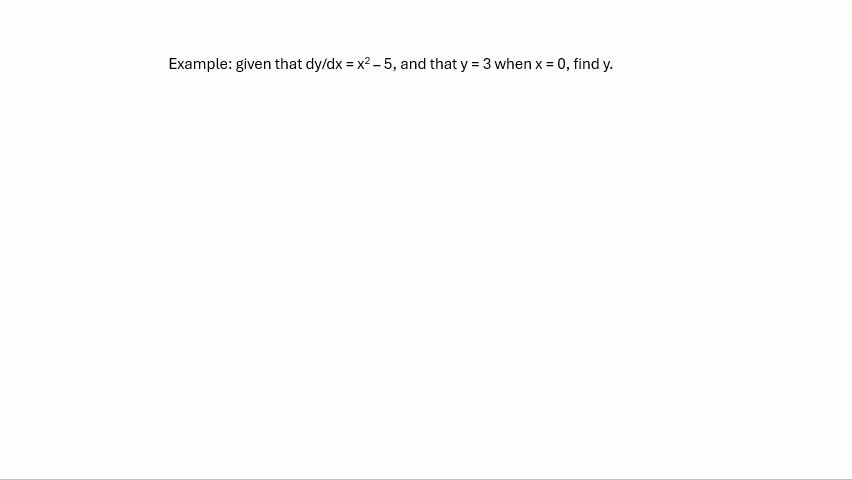
Because the derivative of a constant is zero, the derivatives of x² + 1, x² - 5, x² + c are all the same, namely 2x. So we call ∫2x dx = x² + c, where c is called the 'arbitrary constant'. This is called an indefinite integral as it is not unique. We can find c if we are given a point on the curve of the integral and substitute the coordinates to find c. [Text]
Definite Integrals
While it's a good idea to check answers using a definite integral button on your calculator, in most exams you will be required to show working for the integral. If the curve goes below the x-axis the definite integral works out to be negative, so to find areas above and below the x-axis you need to work them out separately and discard negative signs. [Text]

Area between Curves
Sketch the two curves and find their points of intersection. You can then combine the two integrals into one as in the following example. [Text]

Derivatives from First Principles
Just investigating the gradient of curves at different x-coordinates doesn't prove anything. Why is the derivative of x^2 equal to 2x? The gif below shows how we can find derivatives from first principles (without quoting formulas). In it, P has x-coordinate a and Q has x-coordinate a+h. The chord joining P and Q is seen to approach the tangent at P as h gets smaller and smaller.
The gradient of the chord is [f(a+h) - f(a)]/h. So the gradient of the tangent must be the limit of this expression as h tends to zero. Click the video below for an example.[text].


Why dy/dx? We call a small change in x δx, and if we write h, the small change in y, δy, then the gradent of the chord becomes δy/δx. So the tangent is the limit of this expression as δx tends to zero, and this is written dy/dx. At the end of the limit process, dx and dy both become zero, so dy/dx becomes 0/0! But the limit exists nevertheless, as we can cancel an 'h' top and bottom algebraically, as in the example. You can see this happen on the gif above, when Q momentarily crashes into P and the chord instantaneously disappears!