Sequences and Series

Types of Sequence, sigma notation, Arithmetic Sequences, Geometric Sequences , Binomial Expansions
Why we study this
We study arithmetic series because they help us understand patterns that grow by the same amount each time. This makes them useful for finding totals quickly, such as regular savings, repeated payments, or distances that increase steadily. Learning arithmetic series also strengthens our skills in spotting patterns and building clear, step-by-step solutions.
Geometric series are important because they describe change by the same factor rather than the same difference. They help us model growth and decay, including compound interest, population changes, repeated discounts, and scientific measurements. Studying them gives us a practical way to understand how small repeated changes can create large results over time.
Binomial expansions allow us to multiply out powers of 2-term expressions like (1 + 2x)^5, but have important applications in statistics - the binomial distribution - and can be generalised to give the first example of how to break down a function into a power series. They can also be used to prove that the derivative of xⁿ is n xⁿ⁻¹, and were an important step in the development of calculus.
History of Sequences and Series


Carl Friedrich Gauss (1777–1855)
Blaise Pascal (1623–1662)
The study of series has a long history. Mathematicians have used patterns of numbers to solve problems about measurement, finance, science, and change. Arithmetic and geometric series help us find totals and understand how quantities grow or decrease over time.
A famous story tells how young Carl Friedrich Gauss, when aged about 10, was asked to add the numbers from 1 to 100 as a punishment. He quickly noticed that the numbers could be paired: 1 + 100, 2 + 99, and so on. Each pair equals 101, and there are 50 pairs, giving a total of 50 × 101 = 5050. This is a simple example of an arithmetic series
Binomial series are closely linked to Blaise Pascal and Pascal’s triangle. The numbers in the triangle give the coefficients used when expanding powers such as (a + b)^n. Each row is formed by adding neighbouring numbers from the row above, creating a simple pattern with powerful uses in algebra and probability.
Pascal’s work helped show how number patterns, combinations, and algebraic expansion connect. Studying these ideas gives us a clearer view of how series developed and why they remain important in modern mathematics.

Sequences and Series Exam Tips

What is the difference between a sequence and a series? In common language not a lot, but technically a series refers to a sum of terms rather than a list of terms. Word problems for arithmetic and geometric series can best be solved by spotting the sequence, identifying the variables (a, d, r, n, ...) then using the standard formulae. But don't mix up the term and the sum formulae!
Types of sequence

Arithmetic sequence: 1, 3, 5, 7, 9, ... (a = 1, d = 2)

Alternating sequence: 2, -2, 2, -2, ...
We can define sequences using an iteration formula such as uₙ₊₁ = 2uₙ-1, u₁ = 1.
u₂ = 2u₁ − 1 = 1, u₃ = 2u₂ − 1 = 1, ... so the sequence is just 1, 1, 1, ...
This is also called a recurrence relation.
The capital greek letter sigma, Σ, is used in maths to denote 'the sum of' and can be used to define a sequence

Solution: (3² − 1) + (4² − 1) + (5² − 1) + (6² − 1) + (7² − 1) = 8 + 15 + 24 + 35 + 48 = 130.

Geometric sequence: 2, 3, 4.5, 6.75, ... (a = 2, r = 1.5)

Oscillating sequence, period 3: 1, 2, -1, 1, 2, -1, ...
Arithmetic sequences
Algebraic questions usually require you to formulate simultaneous equations in a and d and then solve them. Here's an example
Term: uₙ = a + (n − 1)d
Sum: Sₙ = 1⁄2 n [2a + (n − 1)d]
Sₙ = 1⁄2 (a + l)
Example: An arithmetic sequence has third term 9 and the sum of its first 20 terms is 480. Find the first term and common difference.
Solution: a + 2d = 9 and S₂₀ = 10(2a + 19d) = 480, so 2a + 19d = 48. Substituting a = 9 − 2d gives 18 + 15d = 48, so d = 2 and a = 5.
For problems in context, first identify a and d, then formulate equations, solve and interpret in the context.
Example: You start with £100 in a savings account. In the first month you save £20, and each month you save £5 more than in the previous month. How much money will you have after one year?
Solution: The 12 monthly payments form an arithmetic series with a = 20, d = 5 and n = 12. The total saved is S₁₂ = (12 ÷ 2) [2(20) + 11(5)] = 6(95) = £570. Including the initial £100, the amount after one year is £100 + £570 = £670.
If asked to sum from, say, 50 to 100, you can subtract the sum from 1 to 49 from the sum from 1 to 100.

Geometric sequences
Remember that the sum to infinity formula only applies for -1 < r < 1.
As with APs, algebraic questions on GPs usually require you to formulate simultaneous equations in a and r and then solve them. Here's an example
Term: uₙ = arⁿ⁻¹
Sum: Sₙ = a(rⁿ − 1)⁄(r − 1)
Sum to infinity: S∞ = a⁄(1 − r), for |r| < 1
Example: A geometric sequence has 2nd term 12 and sum to infinity 48. Find the first term a and common ratio r.
Solution: ar = 12 and a/(1 − r) = 48. From the second equation, a = 48(1 − r). Substitute: 48r(1 − r) = 12, so 4r(1 − r) = 1, and 4r² - 4r + 1. Solving this equation gives r = 1/2. Therefore, a = 48(1 − 1/2) = 24. Answer: a = 24 and r = 1/2.
For problems in context, first identify a and r, then formulate equations, solve and interpret the answer in context.
Example: A science experiment starts with 800 bacteria. The number of bacteria increases by 25% each hour. Estimate the total number of bacteria present over the first 6 hours, treating the hourly populations as a geometric series.
Solution: The hourly populations form a geometric series with a = 800, r = 1.25 and n = 6. The total is S₆ = a(r⁶ − 1) ÷ (r − 1) = 800(1.25⁶ − 1) ÷ 0.25 ≈ 9,007. Therefore, the total across the six hourly readings is approximately 9,007 bacteria.

Achilles and the Tortoise
Geometric series which are convergent to their sum to infinity illustrate that series with an infinite number of terms can sum to a finite limit. This perhaps explains Achilles and the Tortoise, one of the famous paradoxes of the philosopher Zeno who lived the fourth century BC.
Here's a video about this.

Binomial Expansions

You could just take this formula at face value, but where do the nCr's come from? I think it is important to see the connection between this formula and permutations and combinations. The video below explains the connection, and also shows how the formula for nCr comes about.
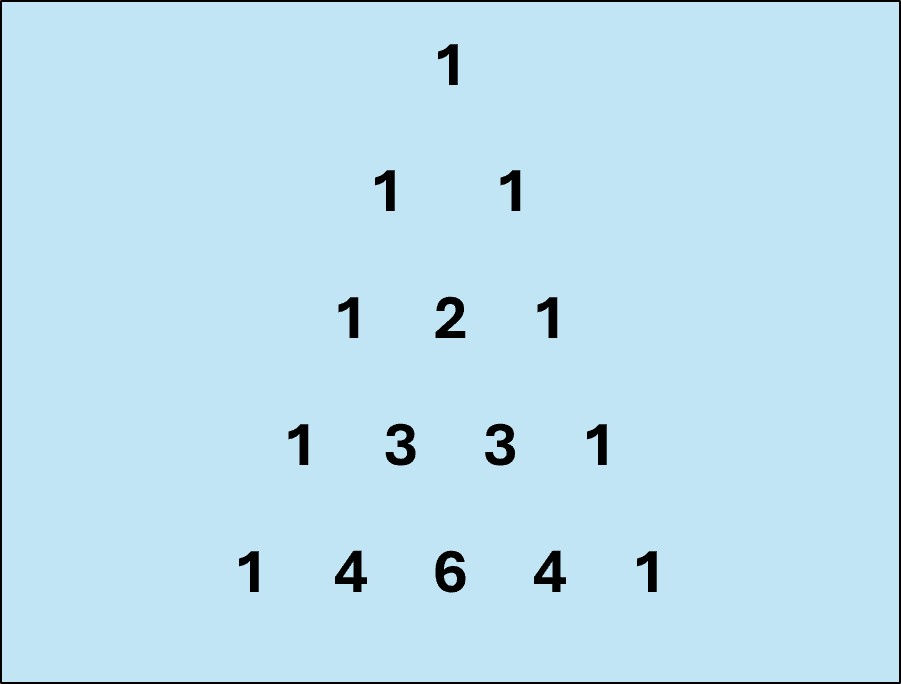
When a or b is negative, put them in a bracket. This helps to avoid errors when evaluating the powers. Pascal's triangle works well for fairly small values of n, say up to 7 or 8.
here's an example.
When n is large, you are usually required to pick out one term rather than compute the whole series expansion. Remember that the powers of a and b add up to n.
An important example of series is Binomial Expansions, The binomial theorem has roots in ancient mathematics, with important developments in China, India and the Islamic world. Blaise Pascal later studied the pattern of coefficients now shown in Pascal’s triangle. In the 17th century, Isaac Newton extended the theorem to fractional and negative powers, producing infinite series such as the expansion of (1+x)½. This work helped support the development of calculus. Here we deal with whole number expansions only.

Example: Expand (2 − 3x)⁴.
Solution: Using the binomial theorem:
(2 − 3x)⁴ = [2 +(− 3x)]⁴ = 2⁴ + 4(2³)(−3x) + 6(2²)(−3x)² + 4(2)(−3x)³ + (−3x)⁴
= 16 − 96x + 216x² − 216x³ + 81x⁴.
Example: Find the constant term in the binomial expansion of (x + 2/x)¹⁰.
Solution: The constant term will have x⁵ and (2/x)⁵ (so the powers of x cancel),Therefore, the constant term is ¹⁰C₅ x⁵ (2/x)⁵ = 252 × 32 = 8064.