Trigonometry 1
Triangles, Radians, Trig Functions, Solving Equations, More Equations
Why we study this
Trigonometric functions are essential to mathematics because they help us understand the relationships between angles, lengths, and shapes. They are used to model repeating patterns, measure distances that cannot be reached directly, and solve problems involving triangles and circles. From calculating the height of a building to describing the movement of waves, sound, and light, trigonometry turns real-world patterns into clear mathematical rules.
They have also played a major role in the development of mathematics by connecting geometry, algebra, and later areas such as calculus and physics. By studying sine, cosine, and tangent, mathematicians have built tools for navigation, astronomy, engineering, architecture, and computer graphics. Trigonometric functions remain important because they help us describe both the precise shapes we see and the changing patterns found throughout the world.

History of Trigonometry

Trigonometry has a long history that began with the study of astronomy, surveying, and the measurement of triangles. Ancient Babylonian and Egyptian mathematicians used practical methods to study angles and distances. Greek mathematicians later developed these ideas further, linking geometry with the movements of the Sun, Moon, and stars.
Hipparchus, a Greek astronomer who lived around the second century BCE, is often called the father of trigonometry. He created one of the earliest known tables connecting angles with the lengths of chords in a circle. These tables helped astronomers make more accurate calculations and predict the positions of celestial objects.
Over time, mathematicians in India, the Islamic world, and Europe developed the ideas of sine, cosine, and tangent into the functions we use today. Trigonometry later became closely connected to algebra and calculus, making it an essential tool in astronomy, navigation, engineering, physics, and modern mathematics.
In the British museum you will find the Rhind Mathematical Papyrus, also known as the Ahmes Papyrus. This is an important ancient Egyptian mathematical text written around 1650 BCE. It contains practical problems involving arithmetic, geometry, fractions, and measurements. Although it does not present trigonometry in the modern form, its work with slopes and the dimensions of pyramids shows how early Egyptian mathematicians used ideas related to angles and ratios.


Trigonometry Exam Tips
Triangles
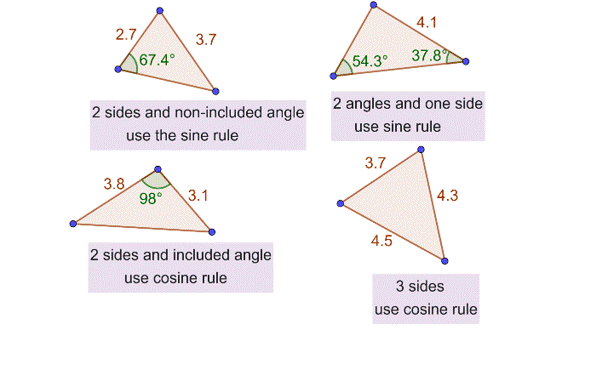
You will no doubt be familiar with solving problems with right angled triangles - most people use the well known mnemonic 'SOHCAHTOA' for this. Isosceles triangles are usually best done by splitting into two right angled triangles. For more general triangles, we use the sine rule or cosine rule (see below). The first case is called the 'ambiguous case' because there are sometimes two possible triangles which can be drawn, one acute and another obtuse.

Some questions involve the use of bearings, so it is important to understand them.
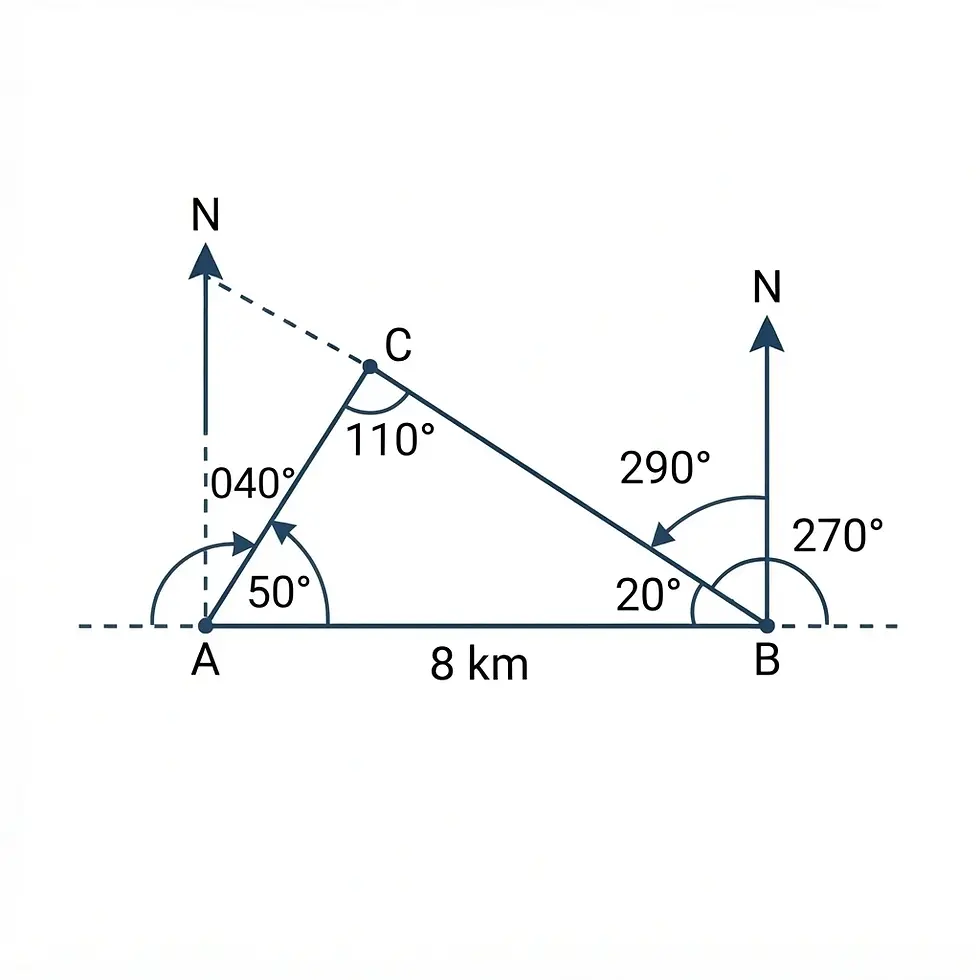
Question: The point B lies 8 km East of the point A. From A, a ship C is on a bearing of 040°. From B, C is on a bearing of 290°. Find AC and BC, giving your answers to 1 decimal place..
Solution: From A, the angle between east (bearing 090°) and AC (bearing 040°) is 50°. From B, the bearing of A is 270°, so angle ABC = 290° − 270° = 20°. Therefore angle ACB = 180° − 50° − 20° = 110°.
Using the sine rule: AC/sin 20° = 8/sin 110°, so AC = 2.9 km. Also, BC/sin 50° = 8/sin 110°, so BC = 6.5 km.
Radians

Why do we need radians? This turns out to be a more 'natural' measure of angle for circles. The length of the arc of a circle is just r θ, where θ is the angle in radians subtended by the arc at the centre, and the area of the sector is just ½ r² θ. There are also advantages in using radians in calculus, as the derivative of sin θ is just cos θ and that of cos θ is just -sin θ.
To convert from degrees to radians, we multiply by π and divide by 180. Vice-versa to convert from radians to degrees. Here is a table of commonly used conversions for angles which are exact multiples of π. It is worth learning these! Others can also be derived from these, so 120 degrees is twice 60, so 2π/3 radians.
Degrees
0°
0
45°
π/4
60°
π/3
90°
π/2
180°
π
360°
2π
Radians
Question: Calculate the area of a segment of a circle of radius 5 cm. The segment subtends an angle of 50 degrees at the centre of the circle.
Solution: Area of segment = area of sector − area of triangle.
Angle in radians = 50 x π/180 = 0.8727
Area of sector = ½ x 5²x 0.8727 = 10.91 cm².
Area of triangle = ½ × 5² × sin 0.8727 = 9.58 cm².
Therefore, area of the segment = 10.91 − 9.58 = 1.33 cm² (to 2 d.p.).
Remember to convert your calculator to radians before calculating the sine!

Trig functions
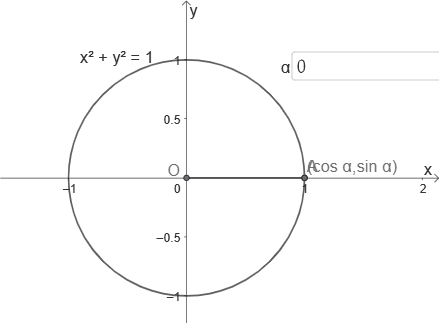
So far we have considered the use of trig functions in triangles. However, 'SOHCAHTOA' only defines the values of these functions for acute angles. How do we define sin 110° in the last question? How can we break the shackles of triangles and define sine, cosine and tangent for all values? The answer turns out to be circles.
The angle α is between a radius and the positive x-axis. This gif shows the angle increasing from 0 to 720°. The cosine and the sine functions are defined as the x- and y- coordinates of a point on the unit circle. We can define them for negative angles by going anti-clockwise round the circle.
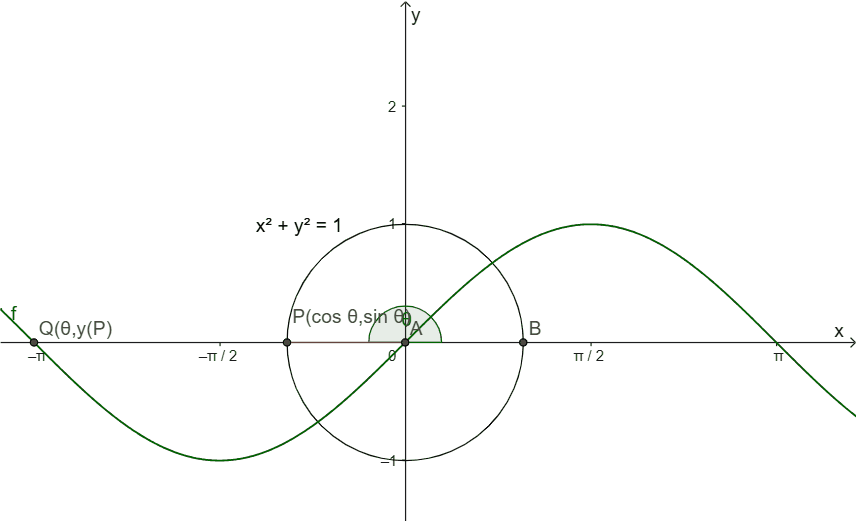
Here we see the point P moving round a unit circle. The point Q has x-coordinate equal to the angle θ measured in radians, and y-coordinate equal to to the y-coordinate of P, This traces the graph of y = sin θ between -π and π.

Now the point Q has y-coordinate equal to to the x-coordinate of P, This traces the graph of y = cos θ between -π and π.

y = sin x, solutions k, 180-k
Degrees of radians?
You can tell from the range of solutions whether you are in degrees (say 0 < x < 360°) or radians (say 0 < x < 2π). You can always work in degrees, then convert solutions in degrees to radians by multiplying by π and dividing by 180.
Solving Trig Equations
Trig equations like sin x = 0.5 have an infinite number of solutions, so unless you are asked for a formula for the general solution (beyond the scope of A level Maths courses), you will be asked to give solutions for a given range of values of x. There are a number of approaches to this. Some use a 'CAST' diagram, which is based on the quadrants of the coordinate plane where the trig functions are positive. It is also possible (if permitted) to use a graphics calculator, by re-arranging the equation to f(x) = 0 form, then drawing the graph for suitable ranges of x and y, and using a 'roots' function to find the zeros.
I prefer to use a sketch of either sin θ = 0, cos θ = 0 or tan θ = 0 to obtain two 'basic' solutions, and then generate a list of solutions for θ which give solutions for x in the equired range.
This diagrams below show the two 'basic' solutions (in degrees) for sin x = a, cos x = a and tan x = a. These also work when a is negative.
Question: Solve the equation sin(2x + 30) = 0.3 for 0 < x < 360°.
Solution: Let θ = 2x + 30. Since sin θ = 0.3, basic solutions θ = 17.46 and 180 - 17.46 = 162.54.
For 30 < θ < 750, θ = 17.46, 162.54, 377.46, 522.54 and 737.46.
Therefore, x = 66.27°, 173.73°, 246.27° or 353.73°.
Note that for a double angle we expect 4 solutions in every 360° as the graph of sin θ will be stretched (in effect 'squeezed') in the horizontal direction with a scale factor 0.5.

y = cos x, solutions k, 360-k

y = tan x, solutions k, 180+k
More Trig Equations

Question: Solve the equation 2 sin x = cos x for −π < x < π.
Solution: Divide by cos x: 2 tan x = 1, so tan x = ½. Therefore, x = tan⁻¹(½) or x = tan⁻¹(½) − π.
Hence, x ≈ 0.464 or x ≈ −2.678 radians.
There are many trigonometric identities which can be used to solve more complicated equations. Here are two which usually figure in the first year of an advanced course.
Here's a right-angled triangle with hypotenuse of length 1 unit.
AB/AC = sin α / 1, so AB = sin α
BC/AC = cos α / 1, so BC = cos α
So AB/BC = tan α = (sin α)/(cos α)
By Pythagoras AB² + BC² = AC², so sin²α + cos²α = 1
These two results are true for all values of α
Question: Solve the equation sin² x = 2 cos x for 0 < x < 2π.
Solution: Using sin² x = 1 − cos² x:
1 − cos² x = 2 cos x, so cos² x + 2 cos x − 1 = 0.
Solving this quadratic in cos x gives cos x = −1 ± √2.
Since cos x cannot be less than −1, cos x = √2 − 1.
Hence, x = cos⁻¹(√2 − 1) or x = 2π − cos⁻¹(√2 − 1).
So, x ≈ 1.144 rad or x ≈ 5.139 rad.
sin α / cos α = tan α
sin² α + cos² α = 1