Vectors

Vector Arithmetic, Geometrical proofs, Components, Vectors in Coordinate Geometry
Why we study this
Some physical quantites like displacement, velocity, acceleration and force all have an intrinsic direction, whereas others, like energy, mass and time do not (though time is perhaps different as it always moves forwards). The former quantities are classed as vectors, the latter as scalars. To add two masses together, we just add the magnitudes; but to add two forces together, we need to take account of their directions.
We can model vector quantities as line segments: the length gives the magnitiude, the direction (as indicated by an arrow) gives the direction of the vector. The position of the line segment is irrelevant, so two parallel line segments of equal length represent the same vector.
We would expect vectors to play a role in physics, given that many physical quantities are modelled by them. We can also use them to prove geometrical theorems, using vectors to represent displacements.
One of the advantages of this is that vectors can use any number of dimensions: 2, 3 or even n!
Vectors play an important role in mechanics, but here familiarise ourselves with vector arithmetic and its uses in geometry.
History of Vectors
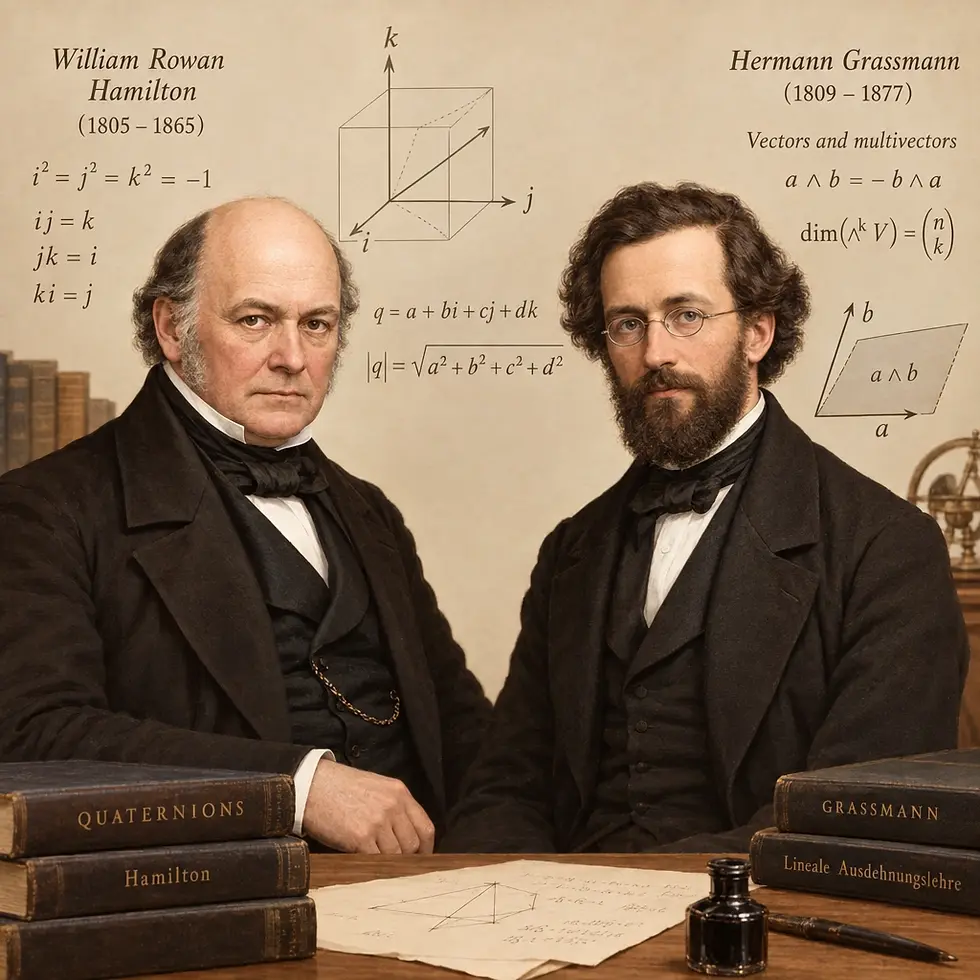
Vectors have a long history, growing from the study of geometry, mechanics, and astronomy. Ancient Greek mathematicians used directed lines to describe shapes and movement, while later scientists developed better ways to represent quantities with both size and direction.
In the 19th century, mathematicians such as William Rowan Hamilton and Hermann Grassmann helped create the algebra of vectors. Their work made it possible to add, subtract, and multiply directed quantities using clear rules. This gave scientists and engineers a powerful language for describing forces, motion, and space.
Today, vectors are used everywhere from physics and engineering to computer graphics and robotics. They help computers represent positions, directions, and movement in games and 3D images. Learning about vectors gives you the tools to understand how objects move and how mathematics describes the world around us.
William Rowan Hamilton (1805–1865) and Hermann Grassmann (1809–1877)

Vectors exam tips
Vectors appear in pure maths questions in the guise of directed line segments. These can be used in questions on plane geometry, including coordinate geometry, where they can describe line segments.
In mechanics, they are used in kinematics - for example projectiles and motion in a plane - and in force systems.
I recommend the you underline vectors, to distinguish them from ordinary variables. In print, vectors are shown in bold; but we can't easily reproduce bold letters, so we use underlining, which is how manuscripts are marked up for converting to a typescript.
Vector arithmetic
To introduce directionality to the arithmetic of vectors requires the introduction of angle into how we define addition. The sum of two vectors can be found using either as the third side of a triangle or the diameter of a parallelogram. We then define scalar multiplication kv by multiplying the length by k and reversing the direction when k is negative. We can then define u - v as u + (-v).
We can also define two multiplication of two vectors by the scalar or dot product (u.v) and the vector product (u x v), but these are not required (or come later) in most advanced mathematics courses.

Of course, these are not arbitrary definitions - they have to characterise how vector quantities actually behave! An example of how vectors do actually model reality when applied to velocities is the Ferry Glide. In order to cross a river under current, a ferry points its bows upstream, so that its velocity relative to the bank is at right angles to the current. This velocity is the vector sum of its velocity relative to the current and the velocity of the current. Here's a video on this - a vector sum in action!





Geometrical proofs
Some questions just ask to identify various directed line segments in a diagram in terms of two base vectors. This is because any vector in a plane can be expressed as a linear combination of two independent (non-parallel) vectors. But this technique gives a powerful method for proving things.
Below is the proof that the midpoints of the sides of any quadrilateral form a parallelogram. The beauty of using vectors is that we don't have to assume the sides are in the same plane! [text]

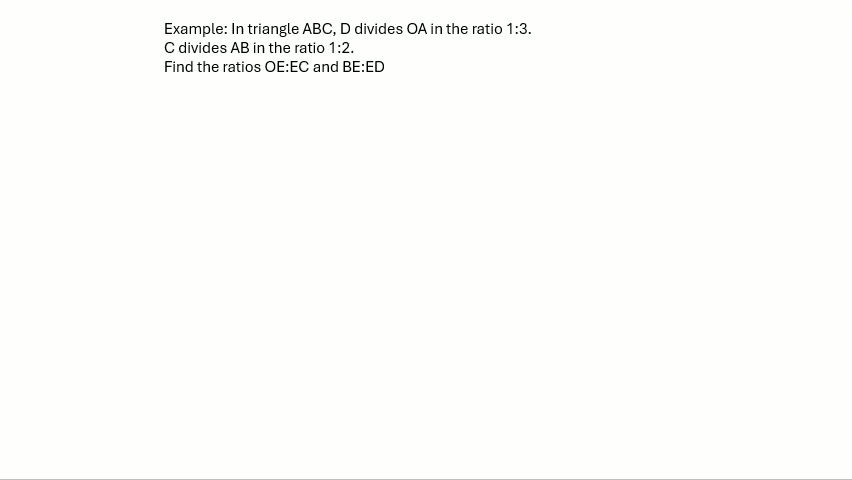
Another technique is to find the intersection of two lines by using the fact that it lies on two vectors. Below is an example of this. [text]
Components

While working with the vector triangle definition of the sum of vectors works well in geometry problems, it's not very convenient when doing calculations with vectors. This is where components come in, as the sum of two vectors is just the sum of their components! The proof is not much harder than common sense - see right. We can express 2D vectors in terms of unit vectors i snd j in two perpendicular directions, and add a unit vector k for three dimensions. But I prefer to convert all of these into column vector form, as it's much easier to equate components by reading across than as coeffcients of i and j (and k).
It is important not to get column vectors mixed up with coordinates, even if they look rather similar. An important idea is postiion vector, which is the vector joining the origin to a point. So the position vector of P(a,b) is ai + bj.
Vectors in Coordinate Geometry
Vectors are often useful in coordinate geometry. For example, if AB is the diameter of a circle, centre O then the vectors for AO and OB are equal. We can then use this to find the coordinates of B from the coordinates of A. Questions involving plane shapes such as parallelograms or trapeziums can also be solved using vectors:
Example: The points A(1,3), B(4, 2), C(-1, 5) and D(5, k) form a trapezium with parallel sides AB and CD. Find k.
Solution: vector AB = 2i - j. Vector CD = 6i +(k - 5)j. These are parallel if 6i +(k - 5)j = λ(2i - j) , so 2λ = 6 , λ = 3 and k - 5 = -λ = -3, k = 2.